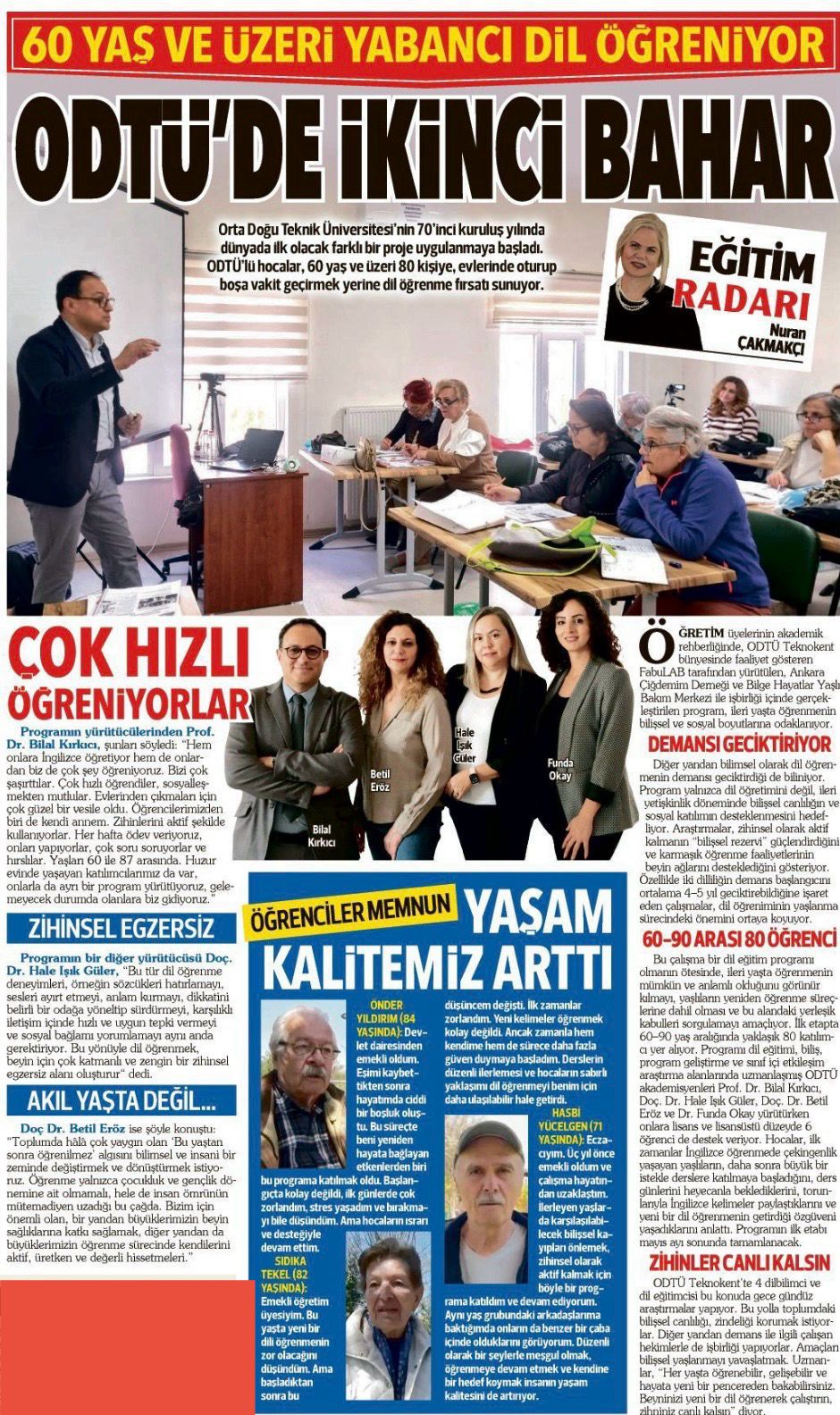
It’s Never Too Late... Over-60s Learn a Foreign Language at METU
Under the academic guidance of faculty members, the program is run by FabuLAB, which operates within METU Technopolis, in collaboration with the Ankara-based Çiğdemim Association and Bilge Hayatlar Elderly Care Center. It focuses on both the cognitive and social dimensions of learning in later life.
MAY HELP DELAY DEMENTIA
Scientific research suggests that language learning may help delay the onset of dementia. The program therefore aims not only to teach a language, but also to support cognitive vitality and social participation in later adulthood. Studies indicate that remaining mentally active may strengthen “cognitive reserve” and that complex learning activities can support neural networks. Research suggesting that bilingualism may delay the onset of dementia by an average of four to five years further highlights the potential importance of language learning in the ageing process.
80 LEARNERS AGED 60 TO 90
Going beyond a conventional language course, the initiative aims to demonstrate that learning in later life is both possible and meaningful, to encourage older adults to re-engage in learning, and to challenge entrenched assumptions about ageing.
The first phase includes approximately 80 participants aged between 60 and 90. The program is led by METU academics Prof. Dr. Bilal Kırkıcı, Assoc. Prof. Dr. Hale Işık Güler, Assoc. Prof. Dr. Betil Eröz, and Dr. Funda Okay, whose areas of expertise include language education, cognition, curriculum development, and classroom interaction. They are supported by six undergraduate and graduate students.
The instructors said that although some participants were initially hesitant about learning English, they soon began attending the classes with great enthusiasm. Many now look forward eagerly to lesson days, share English words with their grandchildren, and enjoy the confidence that comes with learning a new language. The first phase of the program will be completed at the end of May.
KEEPING MINDS ACTIVE
At METU Technopolis, four linguists and language educators are conducting intensive research in this field. Their aim is to help preserve cognitive vitality and mental fitness in society. They are also collaborating with physicians working on dementia, with the broader goal of slowing cognitive ageing.
The experts emphasize: “You can learn, grow, and see life from a new perspective at any age. Exercise your brain by learning a new language and keep your mind active.”
THEY ARE LEARNING QUICKLY
Prof. Dr. Bilal Kırkıcı, one of the program coordinators, said:
“We are teaching them English, but we are also learning a great deal from them. They have truly surprised us. They have learned very quickly and are happy to socialize. The program has given them an excellent reason to leave their homes. One of the participants is my own mother.
“They are using their minds actively. We give them homework every week, and they complete it. They ask many questions and are highly motivated. Their ages range from 60 to 87. We also have participants living in care homes, for whom we run a separate program. We visit those who are unable to come to us.”
A RICH FORM OF MENTAL EXERCISE
Assoc. Prof. Dr. Hale Işık Güler, another coordinator of the program, said:
“Language-learning experiences of this kind require learners to remember words, distinguish sounds, construct meaning, direct and sustain their attention, respond quickly and appropriately during interaction, and interpret the social context, all at the same time. In this respect, language learning provides the brain with a rich, multilayered form of mental exercise.”
YOU ARE NEVER TOO OLD TO LEARN
Assoc. Prof. Dr. Betil Eröz said:
“We want to challenge and transform, on both scientific and human grounds, the still widespread belief that ‘you cannot learn after a certain age.’ Learning should not be confined to childhood and youth, particularly in an era when human life expectancy continues to increase. What matters to us is not only contributing to the cognitive health of older adults, but also helping them feel active, productive, and valued throughout the learning process.”
PARTICIPANTS ARE DELIGHTED: “OUR QUALITY OF LIFE HAS IMPROVED”
Önder Yıldırım, aged 84: “I retired from the civil service. After losing my wife, I experienced a serious sense of emptiness in my life. Joining this program was one of the things that helped reconnect me with life. It was not easy at first. I struggled greatly during the first few days, felt stressed, and even considered giving up. However, with the encouragement and support of the instructors, I continued.”
-
Sıdıka Tekel, aged 82: “I am a retired faculty member. I initially thought that learning a new language at this age would be difficult. However, my perspective changed after I started. I struggled at first, and learning new words was not easy. Over time, however, I began to trust both myself and the learning process more. The well-structured lessons and the instructors’ patient approach made language learning feel much more accessible to me.”
-
Hasbi Yücelgen, aged 71: “I am a pharmacist. I retired three years ago and left working life behind. I joined this program because I wanted to remain mentally active and reduce the risk of cognitive decline in later life, and I am continuing with it. When I look at friends in the same age group, I see that they are making similar efforts. Keeping regularly engaged in something, continuing to learn, and setting a goal for yourself also improve your quality of life.”